Winter Slip and Fall at a Texas Business: Who Is Liable?
When a cold front rolls into the Rio Grande Valley, it rarely brings snow. It brings days of rain, wet parking lots and, every few winters, a hard freeze that glazes roads and walkways. Store entrances fill with tracked-in rainwater, and parking lots can turn slick overnight. For many Valley families, a fall on one of those surfaces is how a personal injury claim begins.
If you get hurt on a surface like that, the natural question is whether the business should have done something to prevent it. Under Texas premises liability law, the answer often depends on details most people never think about: whether you slipped on rainwater inside or ice outside, what made the surface slick, and how long it had been that way.
Texas courts have drawn some firm lines here, and a few real cases show where they fall. If you’ve been hurt, knowing those lines early can change what you do in the days that follow.
What Winter Hazards Cause Slip and Falls at Texas Businesses?
 Here’s what to watch for during a Texas winter:
- Wet entrances: Rain drips off umbrellas and jackets and gets tracked across tile floors near the doors.
- Soaked, curled or missing mats: A mat that is saturated or too short can leave a wet floor just past its edge.
- Roof and gutter leaks: Heavy rain finds weak spots, and water can pool in aisles far from the entrance.
- Ice during freezes: Parking lots, ramps, steps and walkways can glaze over, and runoff from gutters or sprinklers can refreeze overnight.
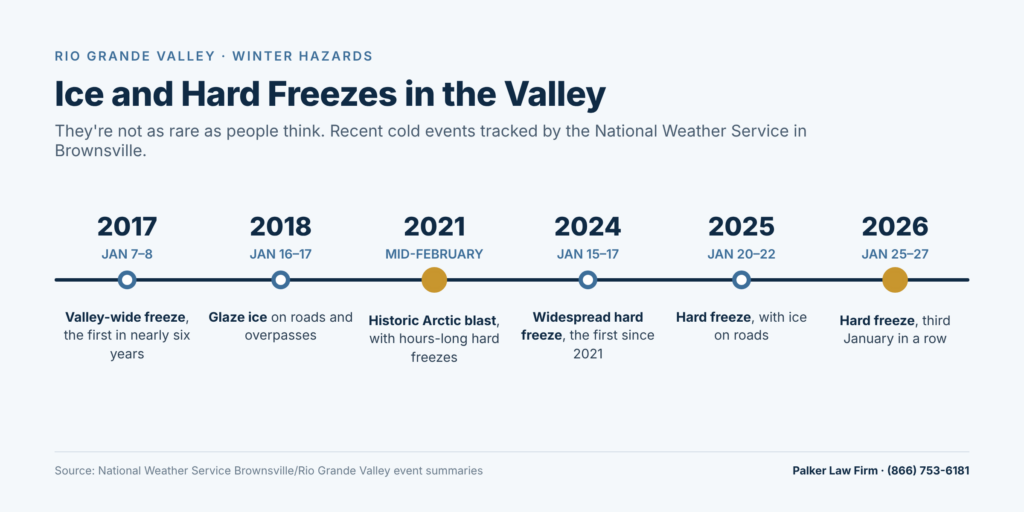
Ice is less rare in the Valley than many people think. In January 2018, the National Weather Service reported freezing drizzle along I-2 and I-69C from Edinburg to Pharr, and vehicles were stranded on glazed overpasses in Harlingen. In February 2021, an Arctic blast brought a record late killing freeze to the RGV. And the cold keeps coming back: the NWS reported that January 2026 brought a hard freeze to the Valley in mid-to-late January for the third year in a row.
For year-round hazards, see our post on 7 hidden dangers that cause slip and fall injuries. And if you’ll be out shopping over the holidays, read what injury victims should know about holiday shopping liability.
When Is a Texas Business Liable for a Slip and Fall?
When you walk into a store, restaurant, clinic or other business open to the public, Texas law generally treats you as an invitee. The Texas Supreme Court has held that a business owes invitees a duty of reasonable care.
That does not make a business responsible for every fall. In general, an injured customer has to show four things:
- A condition on the property posed an unreasonable risk of harm.
- The business knew about it, or reasonably should have known.
- The business did not use reasonable care to fix it or warn you.
- That failure caused your injury.
Texas courts apply this four-part test, set out by the Texas Supreme Court in cases such as Keetch v. Kroger Co. (1992). Winter cases often turn on the first two elements, and that is where the difference between ice outside and water inside comes in.
Ice Outside vs. Water Inside at a Glance
| Naturally formed ice or mud outdoors | Rainwater tracked inside | |
|---|---|---|
| Usually an “unreasonable risk”? | No, as a general rule | Can be; a jury may decide |
| Key case | Scott & White v. Fair (2010) | Rosas v. Buddies Food Store (1975) |
| What helps a claim | A hidden danger under the ice, or ice the business made worse | Proof of how long the water was there and what the business knew |
Why Ice Outside and Water Inside Are Treated Differently
Case Study: The Ice Storm in Temple
The morning after a winter storm, Gary Fair drove his wife to a doctor’s appointment at a hospital in Temple. Ice covered the parking lot, the road between the lot and the hospital, and the steps. After the appointment, he walked out to get the car and slipped on the road.
In Scott & White Memorial Hospital v. Fair (2010), the Texas Supreme Court ruled against the Fairs:
- The holding: Ice that forms naturally on its own is not an unreasonably dangerous condition. The court had already said the same about mud after rain.
- Rarity didn’t matter: The court rejected the argument that ice should be treated differently because it is rare in Texas.
- De-icing didn’t create liability: Putting down deicer did not make the hospital liable. In the court’s words, “To find otherwise would punish business owners who, as a courtesy to invitees, attempt to make their premises safe.”
What this means for you: a fall on naturally formed ice or mud outdoors is usually not a claim on its own. However, the court discussed, without deciding, two possible exceptions:
- The business knew of a more serious danger that the ice was hiding.
- The business’s own conduct turned the ice into an unnatural build-up.
Whether either could apply depends on the facts, which is why being able to show exactly what happened when you fell is so important.
Case Study: The Rainy Afternoon at Buddies Food Store
On a rainy afternoon, Isias Rosas walked into Buddies Food Store through an automatic door with a mat just inside. He slipped on water on the floor just past the mat. The store manager testified that employees mopped near the entrance but could not keep the floor completely dry. He also acknowledged earlier falls on wet floors in that area.
The lower courts treated a wet floor on a rainy day as a normal condition. In Rosas v. Buddies Food Store (1975), the Texas Supreme Court disagreed and sent the case to trial, holding that “reasonable minds could differ as to the dangerous character of the wet floor.”
What this means for you: water inside a business, especially at an entrance where the business knows customers track it in, is treated differently from ice in a parking lot. A jury can decide whether the business did enough. Rosas does not mean every wet floor is a winning claim. It means the store’s own knowledge and habits matter.
Why Timing Can Make or Break Your Case
Case Study: The Toy Aisle Puddle
While shopping in the toy aisle of a San Antonio H-E-B, Marissa Peterson slipped on a clear puddle and fell. The store’s incident report listed “rain” as the source, and video showed the rain had stopped two hours earlier. Footage of the walkways at each end of the aisle indicated no employee had walked down it in that time. The store also had a history of roof leaks, but in a different part of the building.
The Corpus Christi–Edinburg Court of Appeals sided with Peterson. But on April 10, 2026, in H-E-B, LP v. Peterson, the Texas Supreme Court reversed and reinstated judgment for H-E-B. To show the store should have known about the puddle, Peterson needed evidence of how long it had been there, and the record had none. Leaks elsewhere in the store didn’t fill that gap. The court acknowledged that “proving constructive knowledge of transient dangerous conditions like water puddles is difficult,” but it still refused to lower the bar.
Case Study: The Video That Was Recorded Over
In 2004, Jerry Aldridge slipped near a rotisserie chicken display in a Brookshire Brothers grocery store. The store’s cameras recorded in a loop that wrote over footage after about 30 days. The store kept roughly eight minutes of video around the fall. When Aldridge’s lawyer later asked for about two and a half more hours of footage, it had been recorded over almost a year earlier.
A jury awarded Aldridge more than $1 million. In Brookshire Bros. v. Aldridge (2014), the Texas Supreme Court reversed and ordered a new trial because of how the trial court handled the missing video.
What these cases mean for you: in Texas, a wet floor on its own usually isn’t enough. The court will ask how long it was wet and whether the business should have noticed. Evidence that can answer that includes:
- Video from before your fall
- Cleaning and inspection logs
- Witness statements
Much of that evidence is in the business’s hands, and some camera systems record over footage within weeks.
Who Is Most at Risk From a Winter Fall?
Anyone can fall, but the consequences are often more serious for older adults. According to the CDC:
- Falls are the leading cause of injury for adults 65 and older.
- In 2023, 41,400 adults in that age group died from unintentional falls.
- Each year, falls among older adults lead to about 3 million emergency department visits and about 1 million hospitalizations.
Winter weather adds to the risk. After the February 2021 winter storm, the Texas Department of State Health Services confirmed 246 storm-related deaths across 77 counties. They included deaths from trauma or fractures sustained in falls and slips on ice.
If a fall at a business took the life of someone you love, Texas law may give your family the right to bring a wrongful death claim. It sets out who can file and what a family can recover.
Does It Matter If You Were Partly at Fault?
Expect the business or its insurer to say you should have watched your step, worn different shoes or noticed the weather. That argument does not automatically end your claim.
Under Texas’s proportionate responsibility law, you cannot recover if you are found more than 50% at fault. If your share is 50% or less, your recovery is reduced by your percentage of responsibility. For example, if a jury found $100,000 in damages and decided you were 20% responsible, your recovery would be reduced to $80,000.
What Should You Do After a Winter Slip and Fall at a Business?
The steps you take in the first days protect both your health and your claim:
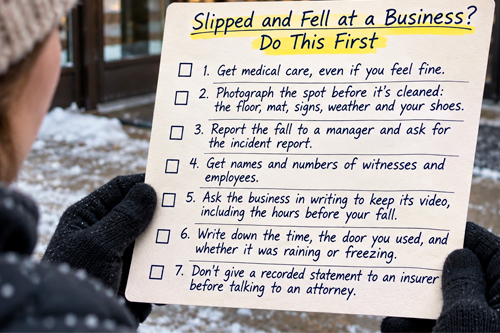
- Get medical care, even if you feel fine. Some injuries show up later.
- Photograph the spot before it is cleaned. Include the floor, the mat, any warning signs (or the lack of them), the weather outside and your shoes.
- Report the fall to a manager and ask for a copy of the incident report.
- Get names and phone numbers of witnesses and the employees you spoke with.
- Ask the business, in writing, to keep its video. Ask for the hours before your fall, not just the fall itself.
- Write down the details: the time, which door you used, whether there was a mat or sign, and whether it was raining or freezing.
- Don’t give a recorded statement to an insurance company before you speak with an attorney.
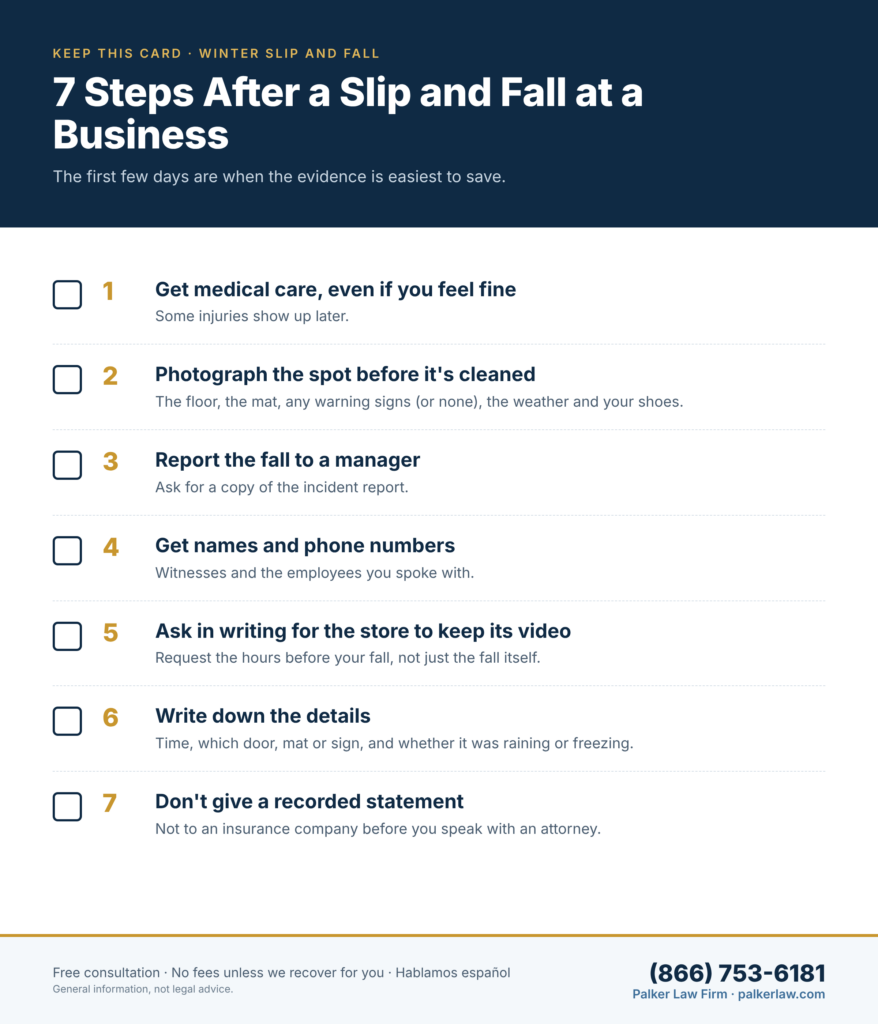
Asking a manager for a report or a copy of the video can feel awkward when you’re hurt and embarrassed, but those first few days are when the evidence is easiest to save. If your injury came from something other than a fall, we also cover what to do immediately after an injury in Texas.
How Long Do You Have to File a Slip and Fall Claim in Texas?
In most Texas personal injury cases, you have two years from the date of the injury to file a lawsuit. For a wrongful death claim, the two years run from the date of death. Claims against a city, county or other government entity follow the Texas Tort Claims Act, which requires written notice within six months, and some cities set shorter deadlines.
Two years gives you time to file, but the evidence may not last that long. The store in the Brookshire case recorded over its footage after about 30 days, so if you wait a month to call a lawyer, the video that could prove your case may already be gone. For a sense of what comes after filing, see how long personal injury cases take in Texas.
Winter Slip and Fall FAQs
 Can I sue if I slipped on ice in a parking lot in Texas? Usually not if the ice formed naturally from the weather. Under Scott & White v. Fair, naturally formed ice is not, on its own, an unreasonably dangerous condition. A claim may still be possible if the ice hid a more serious hazard or the business made the ice worse.
Can I sue a store for slipping on a wet floor on a rainy day? Possibly. Under Rosas, a wet entrance floor can be a dangerous condition, but after H-E-B v. Peterson, you generally need evidence of how long the water was there or that the store knew about it.
How long do stores keep surveillance video? It varies by business. In Brookshire, the store’s system recorded over footage after about 30 days, which is why a written request to preserve video should go out as soon as possible.
What if I fell on a city sidewalk or at a government building? Different rules apply. The Texas Tort Claims Act requires written notice within six months, and some cities require it sooner.
Talk to a Rio Grande Valley Slip and Fall Lawyer Before the Evidence Is Gone
Every winter fall is different, and the details are what these cases turn on. The video, the cleaning logs and the witnesses that can prove how long a hazard was there are often gone within weeks. If you’d like someone to look at your case, our slip and fall attorneys can go over what happened, what caused it and what evidence still exists, and tell you honestly whether you have a claim.
We work on a contingency-fee basis and don’t charge fees up front. If we don’t recover for you, you don’t pay anything for your case.
Contact Palker Law Firm for a free consultation. Hablamos español.
Find a Palker Law personal injury lawyer near you:
- McAllen personal injury lawyer
- Brownsville personal injury lawyer
- Harlingen personal injury lawyer
- Weslaco personal injury lawyer
- El Paso personal injury lawyer
This article is general information, not legal advice. Every case depends on its own facts.